
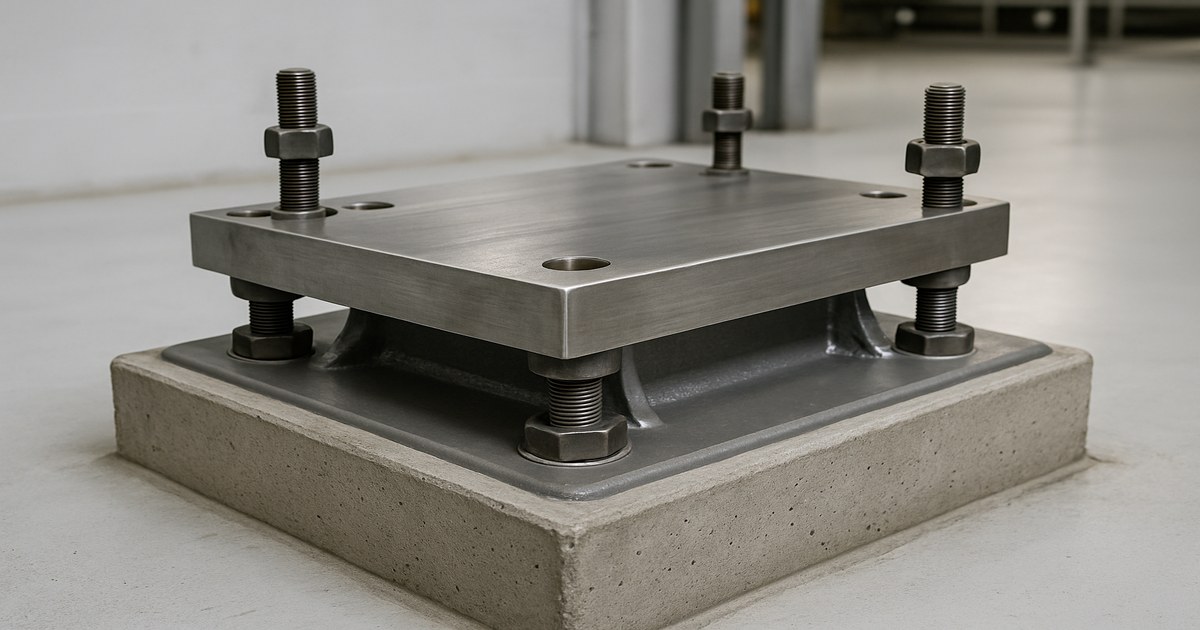
Why Machine Foundations Fail — And Why It Is Usually the Grout
We manufacture both epoxy and cementitious grout, and every year we get the same call from plant maintenance engineers: a pump has started walking out of alignment, coupling life has dropped from three years to eight months, and vibration readings have crept from 2.5 mm/s to over 7 mm/s.
Nine times out of ten the machine is fine. The grout has failed.
There are three common failure modes, and they are all preventable:
> Field data: In 2025 we supplied epoxy grout for the re-grouting of 34 slurry pump foundations at a copper concentrator in Chile. Pre-repair average vibration was 8.1 mm/s RMS. Six weeks after re-grouting with our XQ-GJ-E epoxy grout, the average was 2.9 mm/s. No pump has been re-shimmed since.
Epoxy Grout vs. Cementitious Grout: The Real Comparison
Most articles on this topic tell you epoxy is "stronger." That is misleading — 60 MPa cementitious grout is already stronger than the C30 or C40 foundation concrete it sits on, so extra compressive strength buys you nothing. Here is what actually differs:
| Property | Epoxy Grout (XQ-GJ-E) | Cementitious Grout (XQ-GJ-C60) | Which matters when |
|---|---|---|---|
| Compressive strength | ≥ 80 MPa (7 d) | ≥ 60 MPa (28 d) | Rarely governs — foundation concrete is the weak link |
| 1-day strength | ~65 MPa | ≥ 20 MPa | Fast turnaround / shutdown windows |
| Shrinkage | Effectively zero | Non-shrink (expansive additive), but sensitive to cure conditions | Critical for precision alignment |
| Effective bearing area achievable | 95–98% | 80–90% | Critical for rotating machinery |
| Tensile / flexural strength | ≥ 25 MPa flexural | ~8 MPa flexural | Resisting dynamic uplift |
| Bond to prepared concrete | ≥ 3.5 MPa (concrete fails first) | ≥ 1.5 MPa | Dynamic loads, edge lifting |
| Oil / chemical resistance | Excellent (pH 2–12, hydrocarbons) | Poor — oil degrades the matrix | Refineries, gearboxes, chemical plants |
| Vibration damping | High (polymer matrix) | Low (brittle) | Reciprocating compressors, crushers |
| Coefficient of thermal expansion | ~25–30 × 10⁻⁶ /°C | ~10–12 × 10⁻⁶ /°C | Epoxy needs expansion joints; cement does not |
| Max recommended pour depth per lift | 100 mm | 300 mm+ | Deep pours favour cementitious |
| Working time at 25 °C | 45–60 min | 30–45 min | Both need planning |
| Application temperature | 10–35 °C | 5–35 °C | Cold sites favour cement or a winter-grade epoxy |
| Relative material cost | 4–6× | 1× | Budget |
For a deeper side-by-side on the chemistry, see our epoxy grout vs. cementitious grout guide.
Selecting Grout by Application
| Equipment / application | Recommended product | Why |
|---|---|---|
| Centrifugal & reciprocating compressors | Epoxy grout, 80 MPa | Dynamic load, oil exposure, alignment critical |
| Slurry & process pumps | Epoxy grout, 80 MPa | Vibration damping, chemical splash |
| Steam / gas turbine skids | Epoxy grout, 80 MPa | Thermal cycling, precision |
| CNC machine tools, presses, injection moulding | Epoxy grout or ultra-fine injection grout | Micron-level levelling; UF grout fills gaps ≥ 0.05 mm |
| Wind turbine tower base flange | High-strength cementitious grout, 60–80 MPa | Very large volume, deep section, thermal compatibility with concrete |
| Crusher / mill foundations | Epoxy grout | High impact energy, bolt loosening |
| Steel column baseplates, bridge bearings | Cementitious grout, 60 MPa | Static load, no chemical exposure |
| Emergency / overnight re-grouting | Fast-setting cementitious grout — 30 MPa in 4 h | Shutdown window under 24 hours |
| Submerged or tidal-zone equipment bases | Underwater grout | Anti-washout, ≥ 40 MPa cured underwater |
A note on wind turbine foundations
We get a lot of enquiries for "wind turbine foundation epoxy grout" and it is worth correcting a common misconception. The grout layer between the steel embedment ring or tower base flange and the concrete foundation is typically 50–150 mm thick and several cubic metres in volume. Epoxy grout is a poor choice at that scale for three reasons: exotherm on a thick pour can exceed 90 °C and crack the grout, the thermal expansion mismatch with the surrounding concrete is roughly 2.5:1, and the material cost becomes indefensible.
The correct specification for wind turbine base grouting is a high-strength, non-shrink, flowable cementitious grout with characteristic compressive strength of 60–80 MPa and a flow cone time appropriate for pumping under the flange in a single continuous pour. Epoxy belongs on the *nacelle-side* equipment — the yaw drives, gearbox skids, and generator baseplates — not the tower base. See our wind turbine solutions page for the full material stack.
Installation: The Nine Steps That Decide Whether It Works
The industry reference here is API 686 (Recommended Practice for Machinery Installation and Installation Design), Chapter 5, which is the practical standard for rotating equipment foundations. Material qualification generally follows ASTM C579 (compressive strength of chemical-resistant mortars and grouts) and ASTM C1339 (creep of chemical-resistant polymer grouts) — ask any supplier for both. Cementitious grouts are qualified to ASTM C1107 (non-shrink hydraulic cement grout).
1. Let the concrete cure. Minimum 28 days for new foundations. Grouting onto green concrete guarantees differential shrinkage cracking. 2. Chip the foundation. Remove 20–25 mm of the top surface with a hand-held chipping hammer — never a 15 kg breaker, which micro-fractures the concrete below. Target a surface profile amplitude of at least 6 mm (roughly ICRI CSP 7–9). All laitance must go; the aggregate should be exposed and sound. 3. Chamfer every edge at 45°. Sharp corners are stress risers and are where epoxy grout cracking starts. This single step prevents most corner cracking complaints. 4. Clean the steel. The underside of the baseplate must be blast-cleaned to SSPC-SP 6 / Sa 2½ if you want bond. If you do *not* want bond — for example under a baseplate that must be removable — apply a release wax instead, and say so on the drawing. 5. Set the forms. Leakproof, braced, and set a minimum of 25 mm outside the baseplate perimeter to form a grout shoulder. Build a head box on the pour side at least 100 mm above the underside of the plate to give hydrostatic head. Include air vents and grout holes in the plate at 450 mm centres. 6. Condition the material. Both resin and hardener should sit at 18–25 °C for 24 hours before mixing. Cold epoxy will not flow; hot epoxy will gel in the mixer. Aggregate stays dry. 7. Mix and pour from one side only. Three-component epoxy grout is mixed resin + hardener first (3 minutes, low-speed paddle), then aggregate added gradually. Pour from a single point and let the grout push air ahead of it. Pouring from two ends traps a void in the middle — this is the most common installation defect we see in failure photos. 8. Respect the lift depth. For our epoxy grout, 100 mm maximum per lift. Deeper sections must be poured in successive lifts with the previous lift still tacky, or the exotherm cracks the pour. 9. Cure and torque. At 25 °C, allow 24 hours before removing forms and 48–72 hours before final anchor bolt torque and machine alignment. At 15 °C, double it. Never load a foundation on cure times measured at ideal lab temperature.Expansion joints — the step everyone skips
Because epoxy grout expands and contracts roughly 2.5 times as much as concrete, any grout pour longer than about 1.5 m in a single unbroken run should be divided by expansion joints running from the concrete surface to the underside of the plate. Use closed-cell foam or cork, 12–20 mm thick, located clear of anchor bolts. On a 6 m long compressor skid, that means three or four joints. Skipping them is the second most common cause of epoxy grout cracking after missing chamfers.
Volume, Yield, and What It Costs
Estimating grout quantity is straightforward but easy to get wrong under a baseplate with internal stiffeners:
Volume (litres) = L × W × T (in metres) × 1000 × 1.15The 1.15 factor covers the head box, shoulders, and waste. Then subtract the displacement of the baseplate stiffeners if they sit inside the pour.
| Item | Epoxy grout | Cementitious grout |
|---|---|---|
| Yield per unit | 25 kg set ≈ 12.5 litres | 50 kg bag ≈ 25 litres |
| Density | ~2.0 kg/L | ~2.1 kg/L |
| Typical FOB Ningbo price | USD 3.20–5.60 /kg | USD 0.35–0.70 /kg |
| Cost per litre placed | USD 6.40–11.20 | USD 0.75–1.50 |
| MOQ | 500 kg (20 sets) | 1,000 kg (20 bags) |
| Standard lead time | 12–18 days | 10–15 days |
| Shelf life | 12 months, 5–30 °C, sealed | 6 months, dry storage |
Prices vary with resin market movement, aggregate grading, and packaging. Private-label packaging and customer-specified TDS branding are available from 2,000 kg. Certifications supplied as standard: ISO 9001, SGS material test report, and third-party compressive strength testing per ASTM C579 on request.
Need help specifying a foundation? Send us the equipment type, baseplate dimensions, grout thickness, and operating temperature and our engineering team will return a material selection and quantity take-off within one working day. Request a quote →Repairing a Failed Grout Layer Without Removing the Machine
Full re-grouting means unbolting and lifting the machine. On a running plant that is often impossible. The alternative is pressure injection of the voided zone, and it works well when the void is a debonded plane rather than a crushed grout bed:
A 200–500 mPa·s injection grout will travel through a 0.3 mm debond plane; anything thicker will not. For genuinely tight voids down to 0.05 mm, step down to the ultra-fine grade. This is the same principle used in concrete crack injection — controlled pressure, low viscosity, bottom-up sequencing.
Common Specification Mistakes We See in Enquiries
- Specifying epoxy grout for a 300 mm deep pour. Split it: cementitious grout for the bulk, a 50 mm epoxy cap under the plate.
- Asking for 100 MPa compressive strength. Nothing above about 80 MPa improves foundation performance, and higher-strength formulations are usually more brittle.
- No surface preparation line item in the tender. Preparation is 30–40% of a successful grouting job's labour. If it is not priced, it will not happen.
- Ignoring the temperature at time of pour. A night pour at 8 °C with a standard epoxy will still be soft 72 hours later.
- Grouting the anchor bolt pockets and baseplate in one operation. Pocket grout first, allow it to cure, then grout the bed. Otherwise the pocket grout settles and pulls the bed down with it.
Frequently Asked Questions
Q: What is the best epoxy grout for machinery foundations? A: For general rotating equipment, a three-component epoxy grout with ≥ 80 MPa compressive strength (ASTM C579), zero shrinkage, ≥ 3.5 MPa bond to concrete, and low creep under sustained load (ASTM C1339) is the right specification. Our XQ-GJ-E meets all four. What separates good products from bad ones is creep performance and effective bearing area — not headline compressive strength. Q: How thick should the grout be under a machine baseplate? A: API 686 practice is 25–50 mm of epoxy grout under the plate for most machinery, and the baseplate should sit 50–75 mm above the chipped foundation surface so there is room for the pour plus a shoulder. Below 25 mm the grout cannot flow reliably; above 100 mm in a single epoxy lift, exotherm becomes a problem. Q: How long before I can start the machine after grouting? A: At 25 °C, allow 24 hours before stripping forms, 48 hours before final anchor bolt torque, and 72 hours before running the machine under load. At 15 °C, roughly double each interval. Cementitious grout typically needs 7 days to reach design strength unless you use a fast-setting grade. Q: Can epoxy grout be used for wind turbine foundations? A: For the tower base flange, no — the pour is too thick and the thermal expansion mismatch with the concrete foundation is too large. Use a flowable non-shrink cementitious grout at 60–80 MPa. Epoxy grout is appropriate for the smaller nacelle and drivetrain equipment baseplates. Q: Why did my epoxy grout crack at the corners? A: Almost always one of three causes: foundation edges were not chamfered at 45°, expansion joints were omitted on a pour longer than 1.5 m, or the pour depth exceeded the maximum lift and the exotherm cracked it internally. All three are installation issues, not material defects. Q: What is "effective bearing area" and why does it matter? A: It is the percentage of the baseplate underside actually in contact with sound grout. Rotating machinery specifications typically require 90–95% minimum, verified by hammer sounding or by ultrasonic survey. Below that figure the load path concentrates near the anchor bolts, the plate flexes, and alignment drifts. Shrinkage-free epoxy grout routinely achieves 95–98%; cementitious grout under a large plate often lands at 80–90%. Q: Do I need to blast the underside of the baseplate? A: If you want the grout bonded to the steel — yes, SSPC-SP 6 minimum, and grout within the blast validity window before flash rust forms. If the plate must be removable in future, apply a release agent instead and design the foundation to work in compression only. Q: What is your MOQ and lead time? A: 500 kg for epoxy grout (20 × 25 kg sets) and 1,000 kg for cementitious grout, with 12–18 days and 10–15 days lead time respectively, FOB Ningbo. Samples of 5 kg are available free for qualified projects; we cover the material and you cover the courier.Related Guides
- Epoxy Grout vs. Cementitious Grout: Selection Guide
- Cementitious Grout Types, Strength and Applications
- Concrete Foundation Repair: Methods and Materials
- Concrete Crack Injection: Methods and Materials
- Epoxy Anchor Load Capacity Chart
- Browse our full grouting material range →
*XINCHOR manufactures epoxy grout, non-shrink cementitious grout, and injection grout for equipment foundations in more than 40 countries. Send us your baseplate drawing and operating conditions and we will return a material specification, quantity take-off, and FOB quotation within one working day. Contact XINCHOR — WhatsApp: +86 133 3618 3725 | Email: [email protected]*