
What Is Cementitious Grout and Why Does It Matter?
Cementitious grout is a fluid, pumpable mixture of Portland cement, graded aggregate (or filler), water, and chemical admixtures that is poured or pumped into confined spaces to fill voids, transfer loads, and provide structural continuity. Unlike concrete — which is placed, vibrated, and formed — grout flows under its own weight or low pressure to completely fill the space without mechanical consolidation.
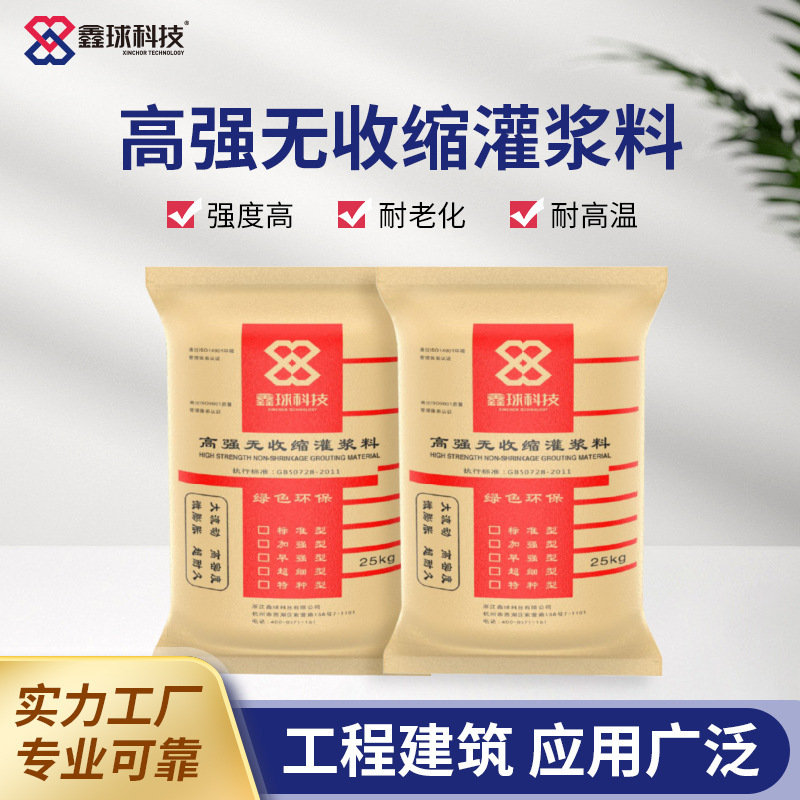
The critical distinction between grout and concrete is flow and self-compaction. Grout must flow through narrow gaps (as small as 10 mm for machine base plates), around obstructions (bolt pockets, reinforcement cages, post-tensioning ducts), and into irregular geometries without segregation or entrapping air. This flow requirement dictates the mix design: high cement content, fine aggregate, superplasticizer, and carefully controlled water content.
As a manufacturer producing five cementitious grout formulations for infrastructure, industrial, and energy sector applications, we supply pre-blended products that require only water addition on site — eliminating the variability of field-batched grouts.
Types of Cementitious Grout
1. Non-Shrink Structural Grout (The Industry Standard)
Non-shrink grout is the baseline product for all structural grouting applications. The "non-shrink" designation means the grout maintains its volume or exhibits slight expansion during the plastic and hardening phases, ensuring full contact between the grout and the substrate surfaces.
Why non-shrink matters: Ordinary cement grout shrinks 0.04 to 0.08% during curing. In a 500 mm grout pocket, this translates to 0.2 to 0.4 mm of gap formation between the grout and the substrate. For a machine base plate that must transfer dynamic loads, this gap allows the plate to rock and vibrate, eventually destroying both the grout and the machine bearings. Non-shrink grout eliminates this failure mode. Our non-shrink grout (XQ-GR-NS):| Property | Specification | Test Standard |
|---|---|---|
| Compressive strength (1 day) | ≥ 20 MPa | EN 12190 |
| Compressive strength (7 days) | ≥ 45 MPa | EN 12190 |
| Compressive strength (28 days) | ≥ 60 MPa | EN 12190 |
| Expansion (restrained, 24h) | 0.01–0.05% | ASTM C827 |
| Expansion (unrestrained, 28d) | 0.00–0.03% | ASTM C1090 |
| Flow (ASTM C939 cone) | 20–30 seconds | Fluid consistency |
| Bleed water (3 hours) | 0% | ASTM C940 |
| Setting time (initial) | 3–5 hours | EN 196-3 |
| Chloride content | ≤ 0.05% | EN 196-2 |
| Packaging | 25 kg bags | Add 3.0–3.5 L water per bag |
- Phase 1 (plastic expansion, 0–24 hours): Gas-generating admixture (controlled aluminum powder reaction) creates micro-bubbles that expand the fresh grout by 0.02 to 0.05%, compensating for settlement and bleeding.
- Phase 2 (hardening expansion, 1–7 days): Expansive cement component (calcium sulfoaluminate) forms ettringite crystals that produce a controlled 0.01 to 0.03% restrained expansion, compensating for autogenous shrinkage.
2. High-Strength Grout (≥ 80 MPa)
For applications requiring compressive strength exceeding that of standard non-shrink grout — typically heavy machinery foundations, bridge bearing plates, and post-tensioning anchor zones:
Our high-strength grout (XQ-GR-HS):| Property | Specification |
|---|---|
| Compressive strength (1 day) | ≥ 35 MPa |
| Compressive strength (7 days) | ≥ 65 MPa |
| Compressive strength (28 days) | ≥ 80 MPa |
| Flexural strength (28 days) | ≥ 12 MPa |
| Expansion (restrained) | 0.01–0.04% |
| Flow | Self-leveling |
| Maximum aggregate size | 2 mm |
The strength increase is achieved through ultra-fine Portland cement (Blaine fineness ≥ 5,000 cm²/g), microsilica addition (8 to 10% by weight of cement), and optimized particle packing with carefully graded aggregate. The low water-to-cement ratio (0.28 to 0.32) requires high-range superplasticizer to maintain flowability.
3. Microfine Cement Grout (Penetration Grout)
For injection into narrow gaps, fine fractures, and porous formations where standard grout cannot penetrate:
| Property | Standard Grout | Microfine Grout |
|---|---|---|
| Maximum particle size (D95) | 50–80 μm | ≤ 15 μm |
| Penetrability | Gaps > 2 mm | Gaps > 0.1 mm |
| Application method | Gravity or low pressure | Injection at 0.5–5 bar |
| Use | Structural grouting | Crack injection, rock grouting, soil permeation |
4. Flowable Fill / Fluid Grout
Low-strength flowable grout for void filling, pipe bedding, and backfill applications where structural strength is not required:
- Compressive strength: 2 to 10 MPa (controlled low strength)
- Self-leveling flow
- High volume applications (cubic meters per pour)
- Excavatable grades available (compressive strength 0.5 to 1.0 MPa — can be re-dug with hand tools)
5. Underwater Grout (Anti-Washout)
Standard cementitious grout disintegrates when placed in water — the cement particles wash away before hydration can occur. Our underwater grout (XQ-GR-UW) contains anti-washout admixtures (AWA) that create a cohesive gel matrix, preventing cement washout in flowing water:
Our underwater grout (XQ-GR-UW):| Property | Specification |
|---|---|
| Compressive strength (28d, underwater cure) | ≥ 40 MPa |
| Anti-washout (CRD-C 61 test) | Mass loss ≤ 2% |
| Flow | Self-leveling under water |
| Setting time | 6–8 hours |
| Application | Tremie pipe or pump placement |
Structural Applications of Cementitious Grout
Machine Base Plate Grouting
The most common structural grouting application worldwide. Machine base plates for generators, compressors, pumps, and turbines must be grouted to the concrete foundation to:
- Transfer static and dynamic loads uniformly
- Eliminate vibration resonance
- Prevent plate movement and bolt loosening
- Provide corrosion protection to the foundation surface
Post-Tensioning Duct Grouting
Grouting of post-tensioning ducts in bridges and buildings serves two critical functions:
- Compressive strength: ≥ 30 MPa at 28 days
- Bleed water: 0% (zero bleed is mandatory — bleed water creates voids that collect at high points of the duct, leaving the tendon unprotected)
- Fluidity: efflux time 14 to 25 seconds (grout cone per EN 445)
- Volume change: expansion 0 to 0.1% at 24 hours; shrinkage ≤ 0.3% at 28 days
- Chloride content: ≤ 0.02% by weight of cement (more stringent than structural grout)
Anchor Bolt Grouting
For grouting anchor bolts, hold-down bolts, and equipment anchors in pre-formed pockets:
- Non-shrink grout ensures full contact between the bolt and the pocket walls
- The grout transfers the bolt's tension and shear loads to the surrounding concrete
- Pocket dimensions: minimum 2 times bolt diameter clearance on all sides
- Grout must flow around the bolt threads and fill to the top of the pocket without air entrapment
Structural Joint Filling
Grouting the gap between precast concrete elements — beams on corbels, columns on pile caps, wall panel connections:
- Non-shrink grout fills the joint and creates load-transfer continuity
- Joint thickness: typically 20 to 50 mm
- Grout strength must match or exceed the lower-strength element (usually ≥ 40 MPa)
- For seismic joints, use fiber-reinforced grout for improved ductility
Grout Strength Classes and Selection Guide
| Strength Class | 28-Day Compressive Strength | Typical Application |
|---|---|---|
| G20 | 20–30 MPa | Non-structural void filling, pipe bedding |
| G40 | 40–50 MPa | General machine base grouting, anchor bolt pockets |
| G60 | 60–70 MPa | Heavy machinery, bridge bearings, column splices |
| G80 | 80–100 MPa | Turbine foundations, nuclear infrastructure, high-load bearings |
Quality Control and Testing
Cube Specimens
Cast a minimum of 6 cubes (100 mm) from each batch:
- 2 cubes tested at 1 day (early strength verification)
- 2 cubes tested at 7 days (progress verification)
- 2 cubes tested at 28 days (compliance verification)
Flow Test
Measure flow using the ASTM C939 flow cone (or EN 445 cone for PT duct grout) for every batch. Record the efflux time and compare to the specification limits. Variation in flow between batches indicates inconsistent water addition — the most common mixing error.
Expansion Test
For non-shrink grout, measure the height change in a restrained expansion test (ASTM C1090 or manufacturer's method). The result should show slight expansion (0.01 to 0.05%) at 24 hours and no net shrinkage at 28 days.
Common Grouting Mistakes
FAQ
Q: What is the difference between non-shrink grout and self-leveling grout? A: Non-shrink describes the volumetric behavior (no shrinkage during curing). Self-leveling describes the flow behavior (flows to a level surface under its own weight without mechanical spreading). Many products are both non-shrink AND self-leveling — including our XQ-GR-NS and XQ-GR-HS. However, not all self-leveling grouts are non-shrink, and not all non-shrink grouts are self-leveling (some require trowel placement). Q: Can I use cementitious grout instead of epoxy grout for machine bases? A: For most machine installations, high-quality cementitious non-shrink grout is sufficient and more economical. Epoxy grout is specified when the base plate is exposed to chemical attack (acid, solvent), when the operating temperature exceeds 80°C, or when the machine generates impact loads that could crack cementitious grout. See our comparison guide for detailed decision criteria. Q: What is the maximum pour thickness for cementitious grout? A: Our XQ-GR-NS can be placed in thicknesses up to 150 mm in a single pour. For pours deeper than 150 mm, add 10 to 15 mm aggregate (pea gravel) to the grout at a ratio of 1 part aggregate to 1 part grout by volume — this reduces heat generation and shrinkage in thick sections. For pours deeper than 300 mm, place in multiple lifts. Q: How long before I can load the grouted base plate? A: Wait until the grout reaches at least 70% of its design strength — typically 3 to 7 days for our products at 20 to 25°C. For the XQ-GR-NS at standard conditions: 1-day strength is ≥ 20 MPa (suitable for light loading), 7-day strength is ≥ 45 MPa (suitable for full service load). Do not apply dynamic loads until 7-day strength is verified by cube testing. Q: Is cementitious grout waterproof? A: No cementitious grout is truly waterproof — all cement-based materials are permeable to some degree. However, our non-shrink grout has significantly reduced water absorption (< 5%) compared to plain cement grout (10 to 15%) due to the dense microstructure and polymer modification. For applications requiring true waterproofing (submerged structures, water tanks), use our epoxy grout or apply a waterproof coating over the cementitious grout.Conclusion
Cementitious grout is the workhorse material for load transfer, void filling, and structural continuity in construction. Selecting the right grout type — non-shrink for standard applications, high-strength for heavy loads, microfine for injection, underwater for submerged placement — ensures the grouted connection performs as designed for its full service life.
View our cementitious grout product range or request a grouting specification with your application details for product recommendations and mixing instructions.